下載億題庫(kù)APP
聯(lián)系電話:400-660-1360
下載億題庫(kù)APP
聯(lián)系電話:400-660-1360

請(qǐng)謹(jǐn)慎保管和記憶你的密碼,以免泄露和丟失
請(qǐng)謹(jǐn)慎保管和記憶你的密碼,以免泄露和丟失
Resource Use through the Business Cycle – Inventory
Inventory accumulation and cutbacks by businesses can occur with such speed and frequency that they have a much greater effect on economic growth than justified by their relatively small aggregate size.
Inventory–sales ratio measures the inventories available for sale to the level of sales.
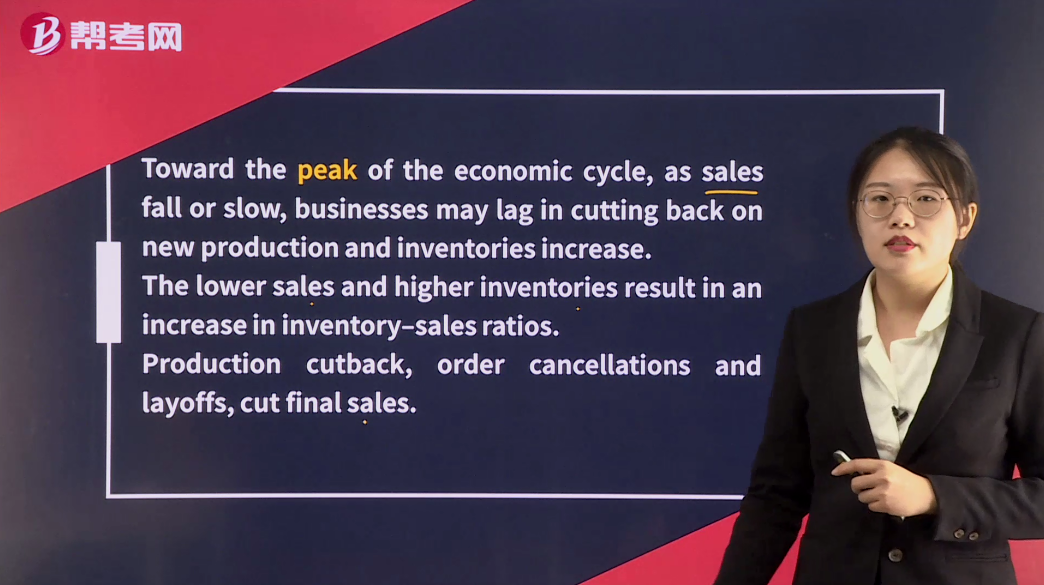
Toward the peak of the economic cycle, as sales fall or slow, businesses may lag in cutting back on new production and inventories increase.
The lower sales and higher inventories result in an increase in inventory–sales ratios.
Production cutback, order cancellations and layoffs, cut final sales.
With businesses producing at rates below the sales volumes necessary to dispose of unwanted inventories, inventory–sales ratios begin to fall back toward normal.
When these indicators return to acceptable levels and businesses no longer have any need to further reduce inventories, they will raise production levels.
As sales begin their cyclical upturn, a business may initially lose inventory to the initial sales increase.
The subsequent fall in inventory–sales ratios, when it occurs in the face of rising sales, quickly prompts a surge in production not only to catch up with sales but also to replenish depleted inventories.
 158
158Theories of the Business Cycle - Monetarist School:Theories of:boom,consider the long-term costs of government intervention e.g.continue to grow at a moderate rate.
 134
134Theories of the Business Cycle - Keynesian School:would be hard to attain.:the economy is already recovering.
 152
152Resource Use through the Business Cycle:which will further increase AD. inventory rebuilding or restocking

微信掃碼關(guān)注公眾號(hào)
獲取更多考試熱門(mén)資料