Elliott Wave Theory
幫考網(wǎng)校2020-08-05 17:37:02
Elliott Wave Theory is a technical analysis approach that attempts to predict future price movements in financial markets by analyzing the patterns of waves. The theory was developed by Ralph Nelson Elliott in the 1930s and is based on the idea that markets move in a series of waves, which are influenced by investor psychology.
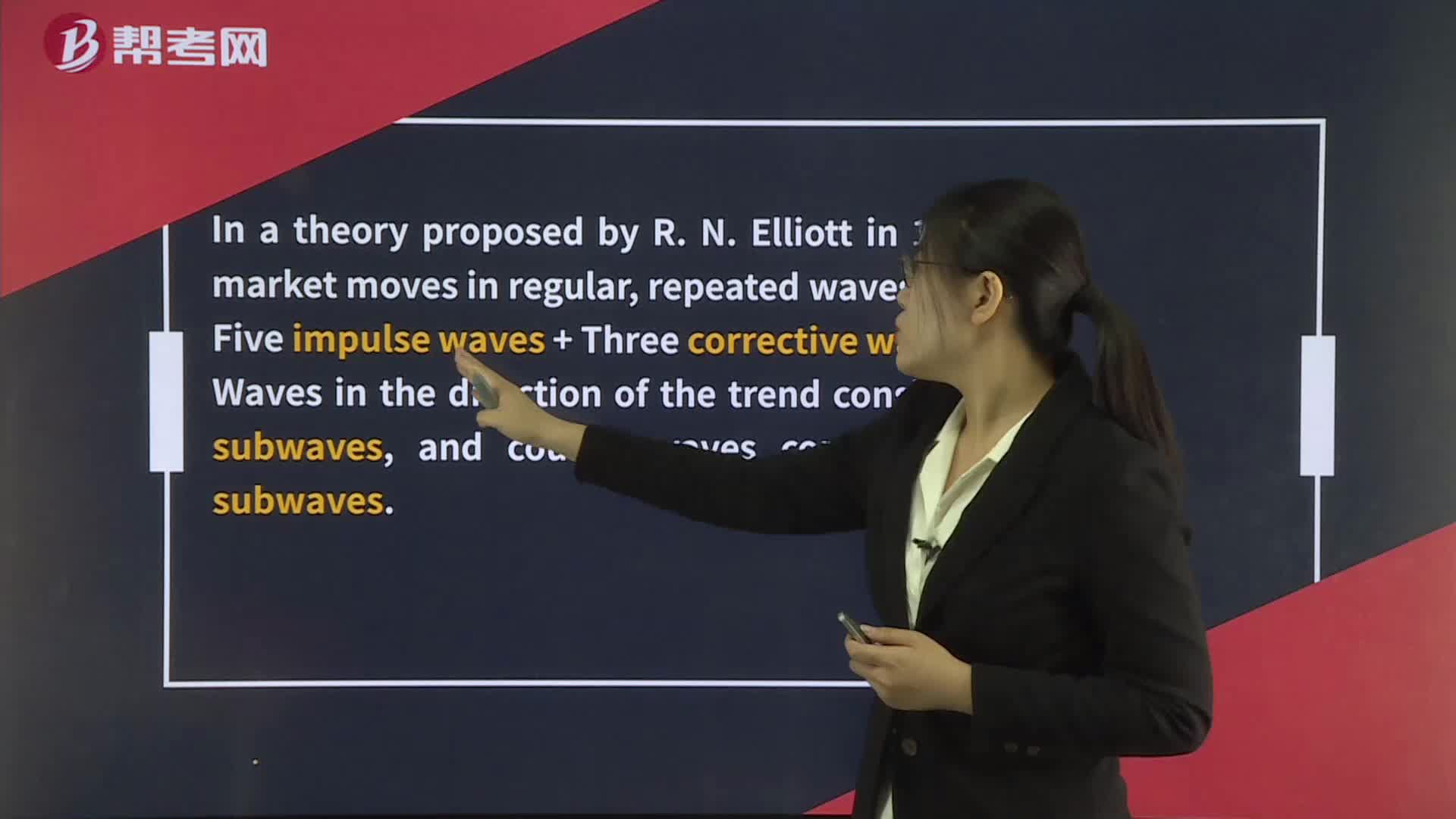
According to Elliott, there are two types of waves: impulse waves and corrective waves. Impulse waves are the larger, directional moves in a market, while corrective waves are the smaller, counter-trend moves. Elliott believed that these waves follow a specific pattern, which he called the "Elliott wave principle."
The Elliott wave principle consists of five waves in the direction of the trend, followed by three waves in the opposite direction. These waves are labeled with numbers and letters, with the impulse waves labeled 1, 3, and 5, and the corrective waves labeled A, B, and C.
The theory also suggests that these waves occur at different degrees, with larger degree waves consisting of smaller degree waves. For example, a five-wave impulse wave on a daily chart could be a smaller degree wave within a larger degree wave that spans several months or even years.
Critics of Elliott Wave Theory argue that it is subjective and difficult to apply consistently, as it relies heavily on interpretation and pattern recognition. However, proponents of the theory believe that it can be a useful tool for identifying potential market reversals and predicting future price movements.
 幫考網(wǎng)校