-

下載億題庫(kù)APP
-
聯(lián)系電話:400-660-1360
下載億題庫(kù)APP
聯(lián)系電話:400-660-1360

請(qǐng)謹(jǐn)慎保管和記憶你的密碼,以免泄露和丟失
請(qǐng)謹(jǐn)慎保管和記憶你的密碼,以免泄露和丟失
Discrete Random Variables
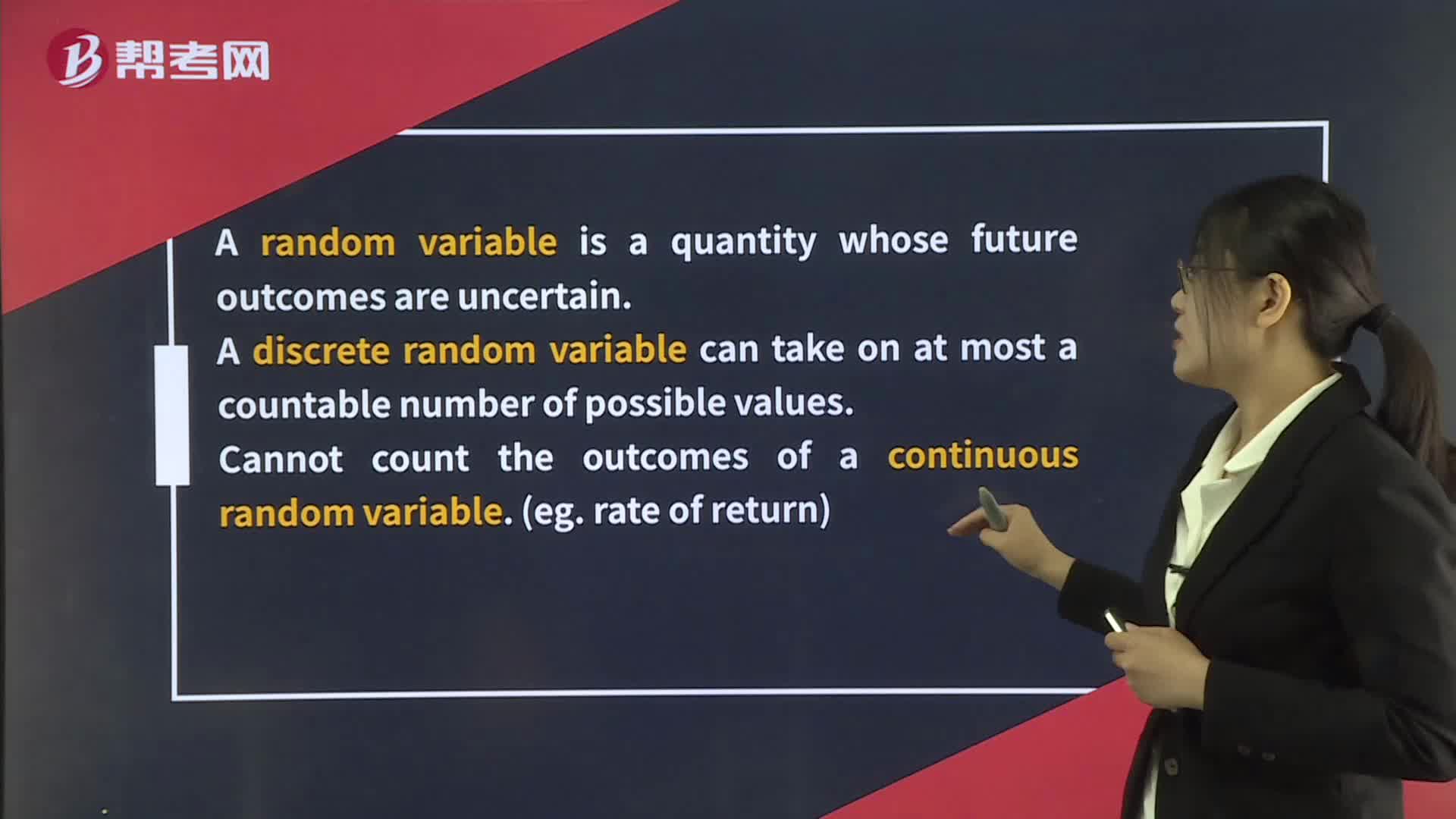
A random variable is a quantity whose future outcomes are uncertain.
A discrete random variable can take on at most a countable number of possible values.
Cannot count the outcomes of a continuous random variable. (eg. rate of return)
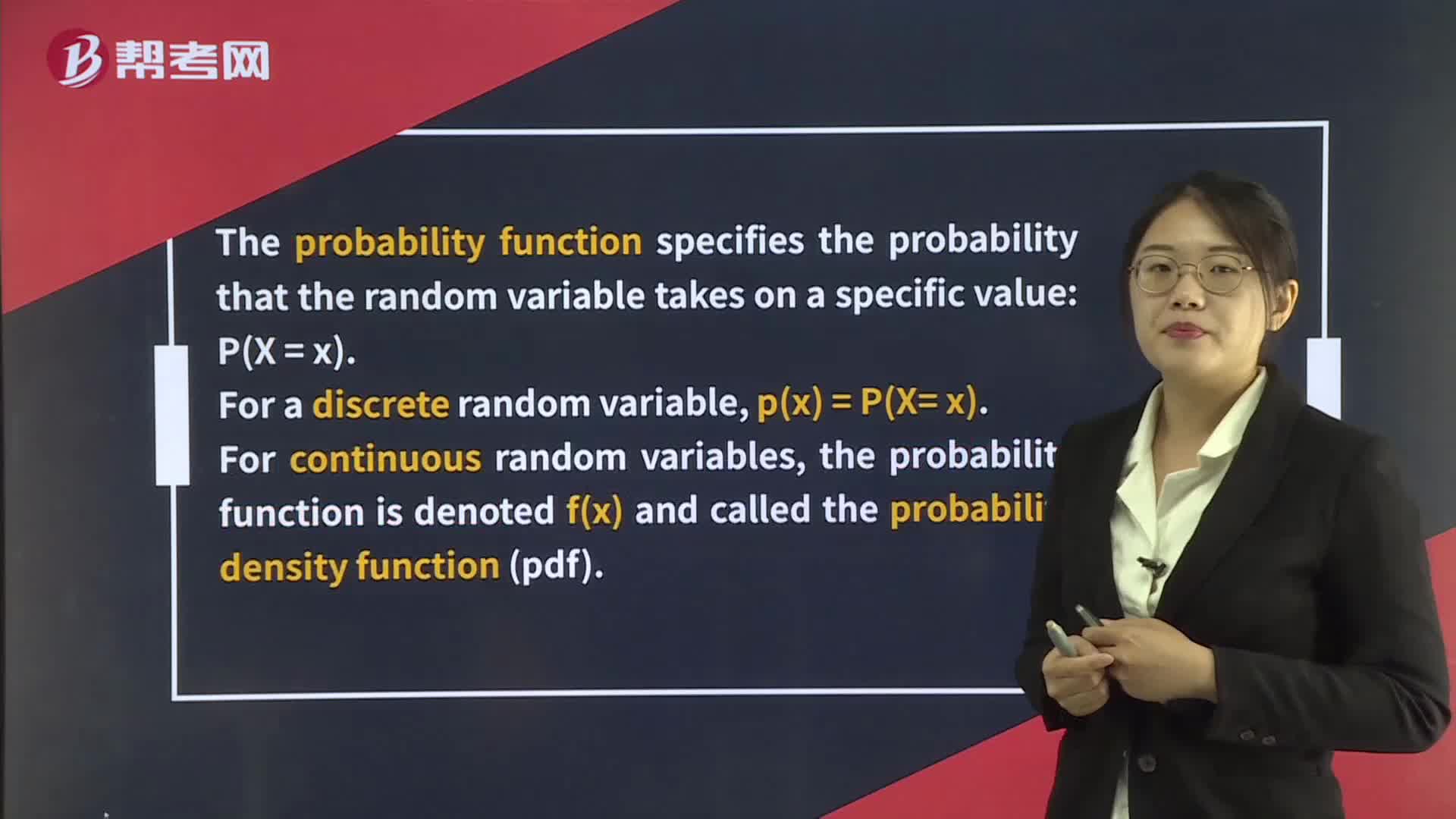
The probability function specifies the probability that the random variable takes on a specific value: P(X = x).
For a discrete random variable, p(x) = P(X= x).
For continuous random variables, the probability function is denoted f(x) and called the probability density function (pdf).
Discrete uniform distribution has a finite number of specified outcomes, and each outcome is equally likely.
A probability function has two key properties:
(1) 0 ≤ p(x) ≤ 1;
(2) The sum of the probabilities p(x) over all values of X equals 1.
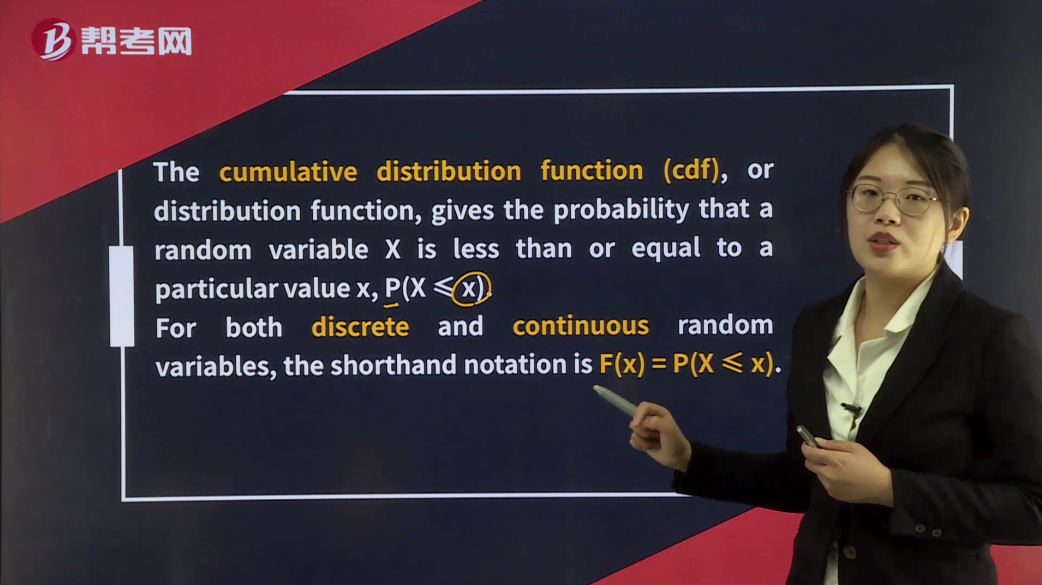
The cumulative distribution function (cfd), or distribution function, gives the probability that a random variable X is less than or equal to a particular value x, P(X ≤ x).
For both discrete and continuous random variables, the shorthand notation is F(x) = P(X ≤ x).
The cdf has two other characteristic properties:
The cdf lies between 0 and 1 for any x: 0 ≤ F(x) ≤ 1.
As we increase x, the cdf either increases or remains constant.
 237
237
Discrete Random Variables:Cannot count the outcomes of a continuous random variable. eg. rate;For a discrete random variable:propertiesremains constant.
 284
284
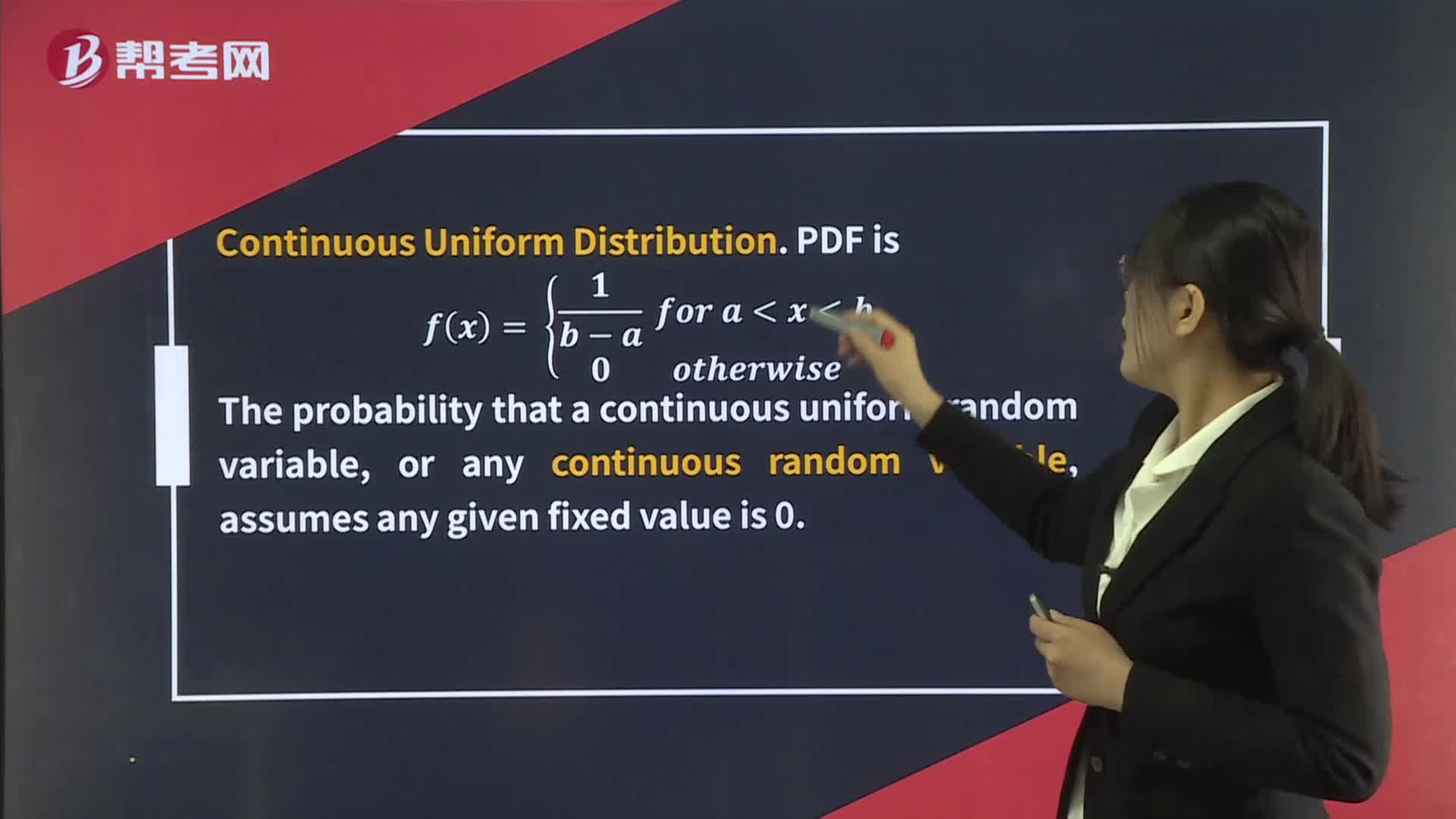
Continuous Random Variables:equal to any fixed point under a continuous uniform distribution is zero.
 969
969
Discrete Random Variables:Cannot count the outcomes of a continuous random variable. eg. rate;density function pdf.,specified outcomes:ThepC.[Practice
 08:39
08:39
2020-05-18
 04:30
04:30
 13:18
13:18
 13:11
13:11
 06:13
06:13
2020-05-15

微信掃碼關(guān)注公眾號(hào)
獲取更多考試熱門資料