
下載億題庫APP
聯(lián)系電話:400-660-1360
下載億題庫APP
聯(lián)系電話:400-660-1360

請謹慎保管和記憶你的密碼,以免泄露和丟失
請謹慎保管和記憶你的密碼,以免泄露和丟失

關(guān)于2020年MPA考試的《英語》考試。幫考網(wǎng)為大家準(zhǔn)備了聯(lián)考英語真題(附答案),幫考網(wǎng)會一步一步陪你備考,每一次練習(xí)的成功,都會淋漓盡致的反映在分數(shù)上。一起加油前行。
Part B
Directions:
Read the following text and answer the questions by finding information from the left column that corresponds to each of the marked details given in the right column. There are two extra choices in the right column. Mark your answers on ANSWER SHEERT 1.(10 points)
“Universal history, the history of what man has accomplished in this world, is at bottom the History of the Great Men who have worked here,” wrote the Victorian sage Thomas Carlyle. Well, not any more it is not。
Suddenly, Britain looks to have fallen out with its favourite historical form. This could be no more than a passing literary craze, but it also points to a broader truth about how we now approach the past: less concerned with learning from forefathers and more interested in feeling their pain. Today, we want empathy, not inspiration。
From the earliest days of the Renaissance, the writing of history meant recounting the exemplary lives of great men. In 1337, Petrarch began work on his rambling writing De Viris Illustribus – On Famous Men, highlighting the virtus (or virtue) of classical heroes. Petrarch celebrated their greatness in conquering fortune and rising to the top. This was the biographical tradition which Niccolo Machiavelli turned on its head. In The Prince, the championed cunning, ruthlessness, and boldness, rather than virtue, mercy and justice, as the skills of successful leaders。
Over time, the attributes of greatness shifted. The Romantics commemorated the leading painters and authors of their day, stressing the uniqueness of the artist\'s personal experience rather than public glory. By contrast, the Victorian author Samual Smiles wrote Self-Help as a catalogue of the worthy lives of engineers , industrialists and explores . "The valuable examples which they furnish of the power of self-help, if patient purpose, resolute working and steadfast integrity, issuing in the formulation of truly noble and many character, exhibit,"wrote Smiles."what it is in the power of each to accomplish for himself"His biographies of James Walt, Richard Arkwright and Josiah Wedgwood were held up as beacons to guide the working man through his difficult life。
This was all a bit bourgeois for Thomas Carlyle, who focused his biographies on the truly heroic lives of Martin Luther, Oliver Cromwell and Napoleon Bonaparte. These epochal figures represented lives hard to imitate, but to be acknowledged as possessing higher authority than mere mortals。
Communist Manifesto. For them, history did nothing, it possessed no immense wealth nor waged battles:“It is man, real, living man who does all that。” And history should be the story of the masses and their record of struggle. As such, it needed to appreciate the economic realities, the social contexts and power relations in which each epoch stood. For:“Men make their own history, but they do not make it just as they please; they do not make it under circumstances chosen by themselves, but under circumstances directly found, given and transmitted from the past。”
This was the tradition which revolutionized our appreciation of the past. In place of Thomas Carlyle, Britain nurtured Christopher Hill, EP Thompson and Eric Hobsbawm. History from below stood alongside biographies of great men. Whole new realms of understanding — from gender to race to cultural studies — were opened up as scholars unpicked the multiplicity of lost societies. And it transformed public history too: downstairs became just as fascinating as upstairs。
[A] emphasized the virtue of classical heroes。
41. Petrarch[B] highlighted the public glory of the leading artists。
42. Niccolo Machiavellli[C] focused on epochal figures whose lives were hard to imitate。
43. Samuel Smiles[D] opened up new realms of understanding the great men in history。
44. Thomas Carlyle[E] held that history should be the story of the masses and their record of struggle。
45. Marx and Engels[F] dismissed virtue as unnecessary for successful leaders。
[G] depicted the worthy lives of engineer industrialists and explorers
Section III Translation
答案:
新題型:
41-45:AFGCE
以上就是本次幫考網(wǎng)和大家分享的全部內(nèi)容了,希望小伙伴們能夠繼續(xù)努力,相信最后一定會取得好成績的。關(guān)注幫考網(wǎng),還有更多有關(guān)考試練習(xí)在等著你哦!
 67
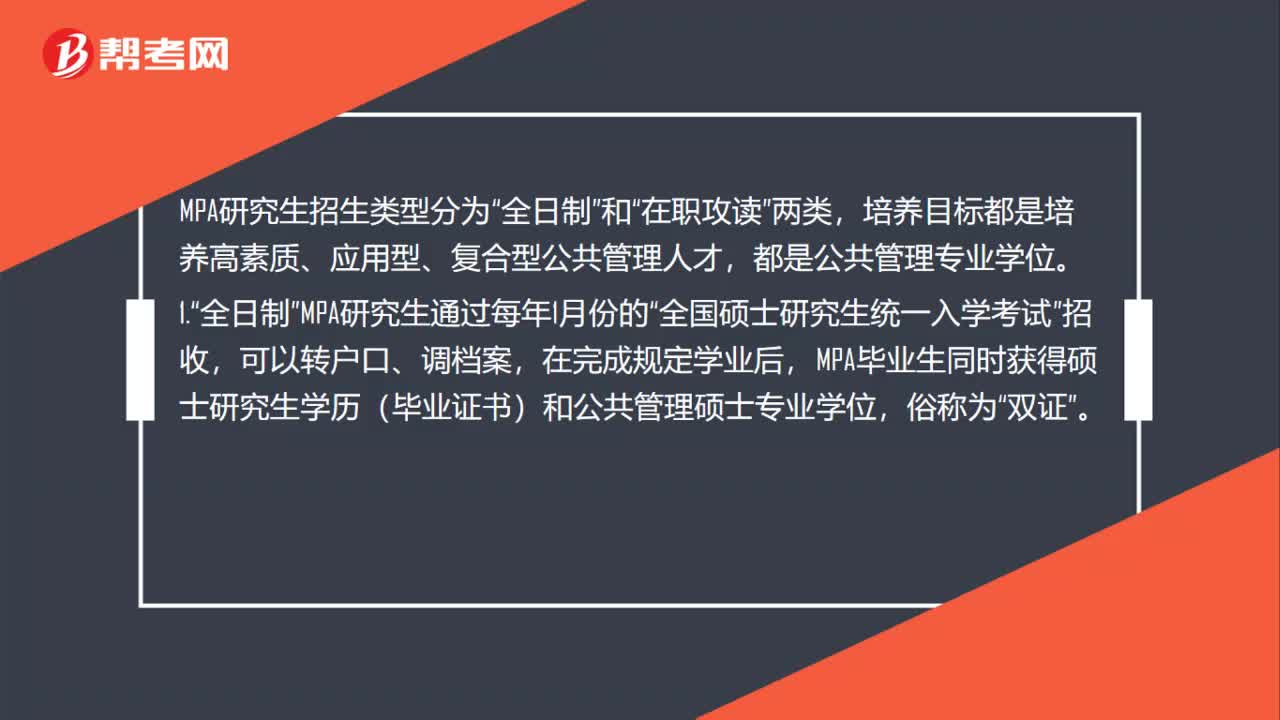
67單證MPA與雙證MPA的異同點是什么?:單證MPA與雙證MPA的異同點是什么?MPA研究生招生類型分為“在職攻讀”培養(yǎng)目標(biāo)都是培養(yǎng)高素質(zhì)、應(yīng)用型、復(fù)合型公共管理人才,都是公共管理專業(yè)學(xué)位。全日制”全國碩士研究生統(tǒng)一入學(xué)考試”可以轉(zhuǎn)戶口、調(diào)檔案,在完成規(guī)定學(xué)業(yè)后,MPA畢業(yè)生同時獲得碩士研究生學(xué)歷(畢業(yè)證書)和公共管理碩士專業(yè)學(xué)位,2.。在職攻讀“MPA研究生通過每年10月份的”在職人員攻讀碩士學(xué)位全國聯(lián)考“招收”不轉(zhuǎn)戶口、不調(diào)檔案。
 93
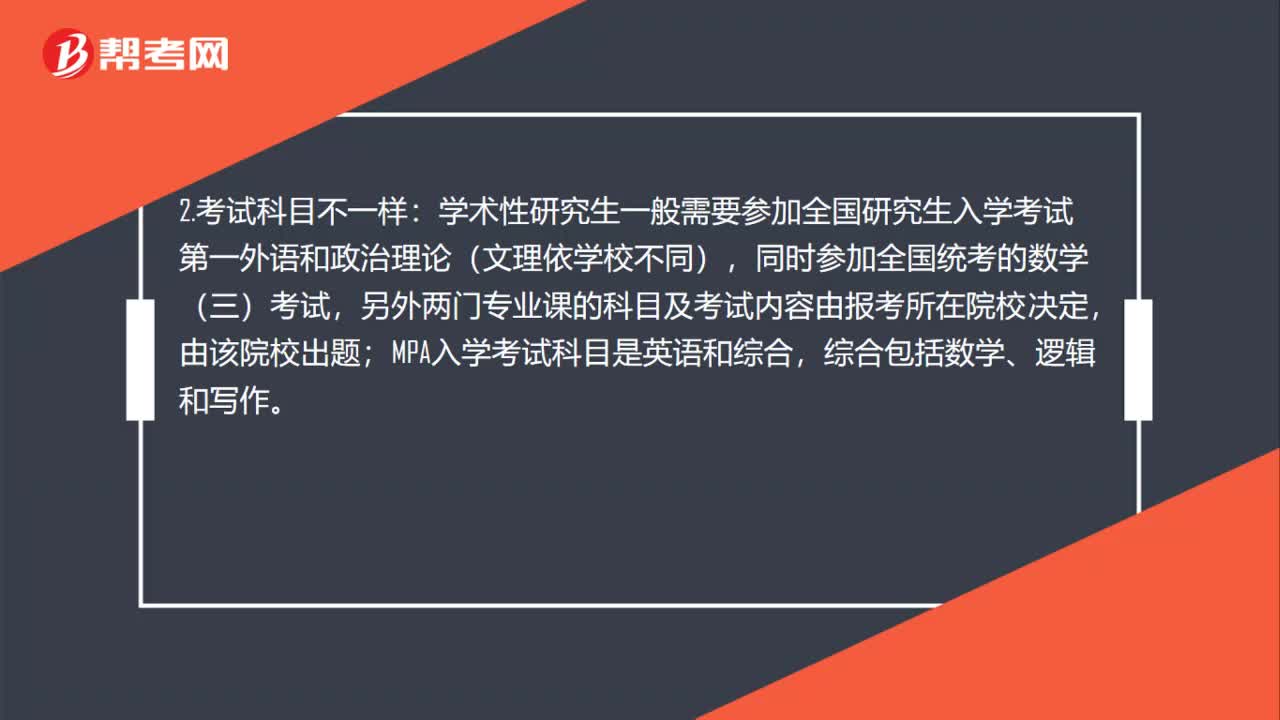
93MPA與學(xué)術(shù)型研究生的區(qū)別是什么?:學(xué)術(shù)性研究生只要符合國家統(tǒng)一的報考規(guī)定即可,應(yīng)屆生與在職人員均可報考。(1)報考MPA必須是大學(xué)本科畢業(yè)后有3年或3 年以上工作經(jīng)驗的人員;(2)大專畢業(yè)后有5年或5年以上工作經(jīng)驗的人員;學(xué)術(shù)性研究生一般需要參加全國研究生入學(xué)考試第一外語和政治理論(文理依學(xué)校不同),同時參加全國統(tǒng)考的數(shù)學(xué)(三)考試,另外兩門專業(yè)課的科目及考試內(nèi)容由報考所在院校決定,MPA入學(xué)考試科目是英語和綜合。
 28
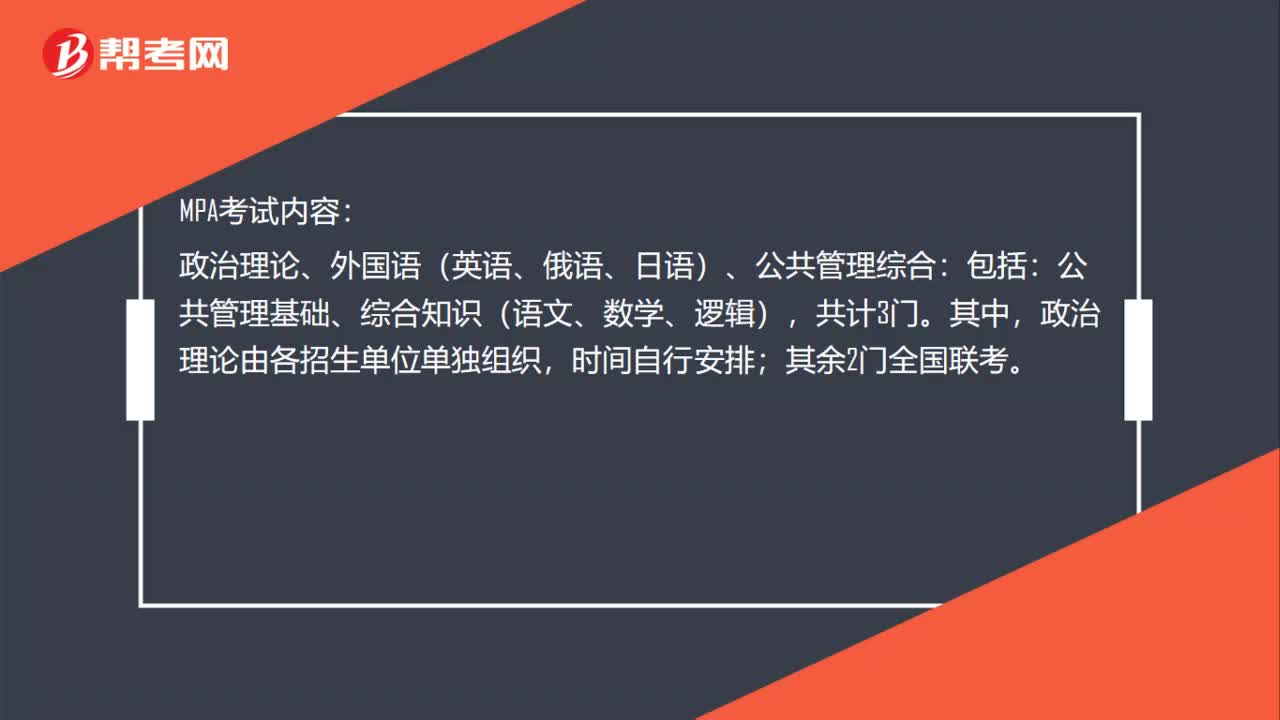
28MPA聯(lián)考考試科目有哪些?:MPA聯(lián)考考試科目有哪些?MPA考試內(nèi)容:政治理論、外國語(英語、俄語、日語)、公共管理綜合:包括:公共管理基礎(chǔ)、綜合知識(語文、數(shù)學(xué)、邏輯),共計3門。其中,政治理論由各招生單位單獨組織,時間自行安排;其余2門全國聯(lián)考。
 00:21
00:212020-06-12
01:072020-06-12
01:332020-06-12
 00:54
00:542020-06-12
 01:23
01:232020-06-12

微信掃碼關(guān)注公眾號
獲取更多考試熱門資料