
下載億題庫APP
聯(lián)系電話:400-660-1360
下載億題庫APP
聯(lián)系電話:400-660-1360

請謹(jǐn)慎保管和記憶你的密碼,以免泄露和丟失
請謹(jǐn)慎保管和記憶你的密碼,以免泄露和丟失

2020年MPA考試《英語》考試。幫考網(wǎng)為大家準(zhǔn)備了英語閱讀理解每日一練題目(附答案),一步一步陪你備考,每一次練習(xí)的成功,都會淋漓盡致的反映在分?jǐn)?shù)上。一起加油前行。
TEXT 9
If sustainable competitive advantage depends on workforce skills, American firms have a problem. Human-resource management is not traditionally seen as central to the competitive survival of the firm in the United States. Skill acquisition is considered an individual responsibility. Labour is simply another factor of production to be hired—rented at the lowest possible cost—much as one buys raw materials or equipment.
The lack of importance attached to human-resource management can be seen in the corporate hierarchy. In an American firm the chief financial officer is almost always second in command. The post of head of human-resource management is usually a specialized job, off at the edge of the corporate hierarchy. The executive who holds it is never consulted on major strategic decisions and has no chance to move up to Chief Executive Officer(CEO). By way of contrast, in Japan the head of human-resource management is central—usually the second most important executive, after the CEO, in the firm\\'s hierarchy.
While American firms often talk about the vast amounts spent on training their work force, in fact they invest less in the skills of their employees than do either Japanese or German firms. The money they do invest is also more highly concentrated on professional and managerial employees. And the limited investments that are made in training workers are also much more narrowly focused on the specific skills necessary to do the next job rather than on the basic background skills that make it possible to absorb new technologies.
As a result, problems emerge when new breakthrough technologies arrive. If American workers, for example, take much longer to learn how to operate new flexible manufacturing stations than workers on Germany (as they do), the effective cost of those stations is lower in Germany than it is in the United States. More time is required before equipment is up and running at capacity, and the need for extensive retraining generates costs and creates bottlenecks that limit the speed with which new equipment can be employed. The result is a slower pace of technological change, And in the end the skills of the bottom half of the population affect the wages of the top half. If the bottom half can\\'t effectively staff the processes that have to be operated, the management and professional jobs that go with these processes will disappear.
1. Which of the following applies to the management of human resources in American companies?
A. They hire people at the lowest cost regardless of their skills.
B. They see the gaining of skills as their employees\\' own business.
C. They attach more importance to workers than to equipment.
D. They only hire skilled workers because of keen competition.
2. What is the position of the head of human-resource management in an American firm?
A. He is one of the most important executives in the firm.
B. His post is likely to disappear when new technologies are introduced.
C. He is directly under the chief financial executive.
D. He has no say in making important decisions in the firm.
3. The money most American firms put in training mainly goes to .
A. workers who can operate new equipment
B. technological and managerial staff
C. workers who lack basic background skills
D. top executives
4. According to the passage, the decisive factor in maintaining a firm\\'s competitive advantage is .
A. the introduction of new technologies
B. the improvement of workers\\' basic skills
C. the rational composition of professional and managerial employees
D. the attachment of importance to the bottom haft of the employees
5. What is the main idea of the passage ?
A. American firms are different from Japanese and German firms in human-resource management.
B. Extensive retraining is indispensable to effective human-resource management.
C. The head of human-resource management must be in the central position in a firm\\' s hierarchy.
D. The human-resource management strategies of American firms affect their competitive capacity.
參考答案:B D B B D
以上就是本次幫考網(wǎng)和大家分享的全部內(nèi)容了,希望小伙伴們能夠繼續(xù)努力,相信最后一定會取得好成績的。關(guān)注幫考網(wǎng),還有更多有關(guān)考試練習(xí)在等著你哦!
 29
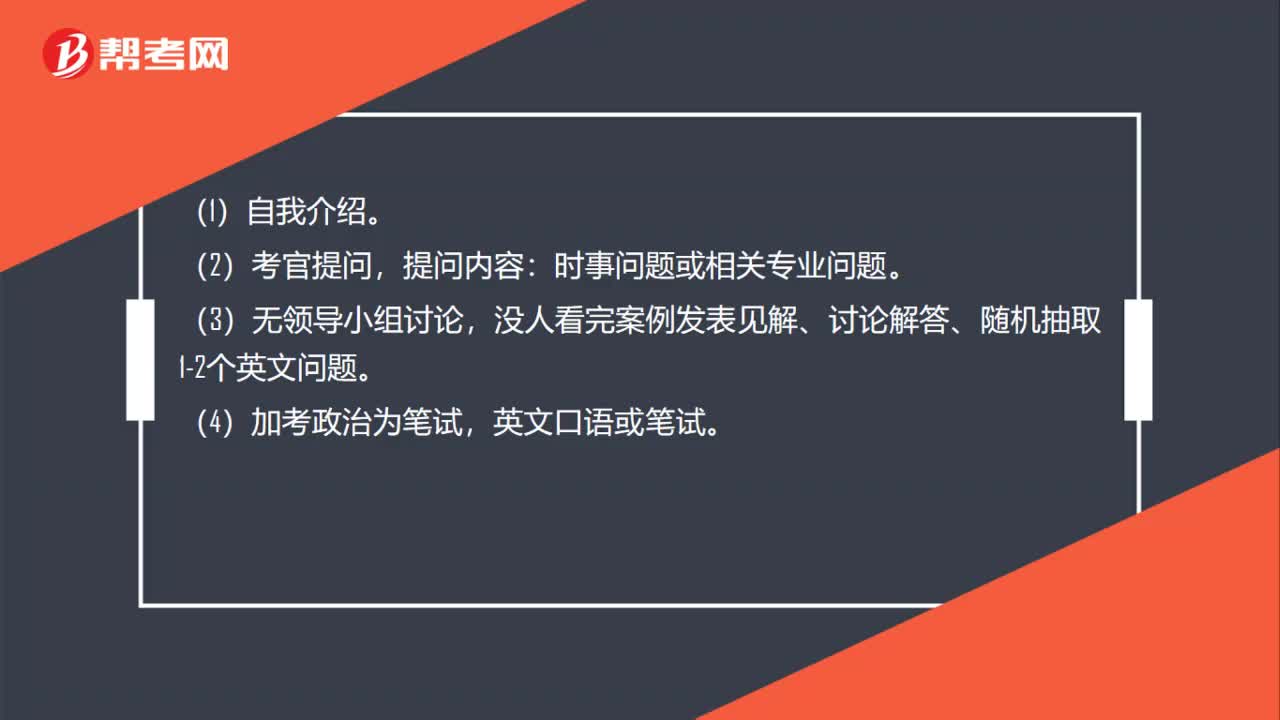
29MPA面試流程是什么?:MPA面試流程是什么?(1)自我介紹。(2)考官提問,提問內(nèi)容:時(shí)事問題或相關(guān)專業(yè)問題。(3)無領(lǐng)導(dǎo)小組討論,沒人看完案例發(fā)表見解、討論解答、隨機(jī)抽取1-2個(gè)英文問題。(4)加考政治為筆試,英文口語或筆試。
 25
25MPA錄取后是否可更改學(xué)習(xí)方式?:MPA錄取后是否可更改學(xué)習(xí)方式?錄取后或入學(xué)后可以更改學(xué)習(xí)方式。錄取后在每年的五月份簽訂培養(yǎng)協(xié)議書時(shí)可以更改學(xué)習(xí)方式(全日制學(xué)習(xí)或在職學(xué)習(xí));入學(xué)后如有特殊情況需要變更學(xué)習(xí)方式,可提交申請,經(jīng)批準(zhǔn)后變更學(xué)習(xí)方式。
 28
28MPA聯(lián)考考試科目有哪些?:MPA聯(lián)考考試科目有哪些?MPA考試內(nèi)容:政治理論、外國語(英語、俄語、日語)、公共管理綜合:包括:公共管理基礎(chǔ)、綜合知識(語文、數(shù)學(xué)、邏輯),共計(jì)3門。其中,政治理論由各招生單位單獨(dú)組織,時(shí)間自行安排;其余2門全國聯(lián)考。
 00:21
00:212020-06-12
 01:07
01:072020-06-12
 01:33
01:332020-06-12
 00:54
00:542020-06-12
 01:23
01:232020-06-12

微信掃碼關(guān)注公眾號
獲取更多考試熱門資料