下載億題庫(kù)APP
聯(lián)系電話:400-660-1360
下載億題庫(kù)APP
聯(lián)系電話:400-660-1360

請(qǐng)謹(jǐn)慎保管和記憶你的密碼,以免泄露和丟失
請(qǐng)謹(jǐn)慎保管和記憶你的密碼,以免泄露和丟失

2019年MBA考試《英語(yǔ)》考試共48題,分為英譯漢和寫作和完形填空和閱讀理解A和閱讀理解B。小編為您整理精選模擬習(xí)題10道,附答案解析,供您考前自測(cè)提升!
1、Why should anyone want to read( )of books by great authors when the real pleasure comesfrom reading the originals?【單選題】
A.themes
B.insights
C.digests
D.leaflets
正確答案:C
答案解析:digest意思是“文摘,摘錄”。譯:既然真正的快樂(lè)來(lái)自于閱讀原著,怎么會(huì)有人想讀名著的摘要呢? theme主題;insight深刻見解,洞察力;leaflet傳單,單頁(yè)。本題when表示“既然”,根據(jù)題意,空格處應(yīng)填“書摘,文摘”之類的名詞,故選C。
2、The advertisement says this material doesn't( )in the wash, but it has.【單選題】
A.contract
B.shrink
C.slim
D.dissolve
正確答案:B
答案解析:shrink意思是“縮水,收縮”。譯:廣告說(shuō)該材料洗時(shí)不縮水,但實(shí)際上已縮水。contract收縮,感染;slim變細(xì),減肥;dissolve溶解。
3、Animals can become usually()when they are upset by a sudden environmental change.【單選題】
A.vigorous
B.predominant
C.aggressive
D.irritable
正確答案:C
答案解析:aggressive意思是“侵略的,好斗的;有進(jìn)取心的”。譯:當(dāng)動(dòng)物由于環(huán)境的突然變化而感到煩躁不安時(shí),通常會(huì)變得好斗。vigorous精力充沛的,有力的;predominant占主導(dǎo)地位的、支配的;irritable易生氣的,煩躁的。
4、Some felt that they were hurrying into an epoch of unprecedented enlightenment, in which bettereducation and beneficial technology would()wealth and leisure for all.【單選題】
A.maintain
B.ensure
C.certify
D.console
正確答案:B
答案解析:ensure意思是“確保(得到)”。譯:一些人認(rèn)為他們正快速步入一個(gè)前所未有的開明時(shí)代,在這個(gè)時(shí)代,更好的教育和有利的技術(shù)將確保所有人的富有和閑暇。maintain維持,保養(yǎng),供養(yǎng);certify證明;console安慰。
5、My father asked( ).【單選題】
A.Tom and me to help
B.me and Tom to help
C.I and Tom to help
D.Tom and I to help
正確答案:A
答案解析:【考點(diǎn)】代詞的格式與人稱的次序
【譯文】父親叫我和Tom去幫忙。
【解析】作為ask的賓語(yǔ),其后的名詞和代詞需用賓格形式,不能用主語(yǔ)格式I,故C、D排除;而人稱的排序則為先第二人稱,再第三人稱,最后是第一人稱,故Tom在前,選A。
6、Our home is finer than( ).【單選題】
A.yours or him
B.your's or his
C.you or he
D.yours or his
正確答案:D
答案解析:【考點(diǎn)】名詞性物主代詞
【譯文】我們家比你家或他家都好。
【解析】根據(jù)our home和than可知是“家”的比較,故than之后需用名詞性物主代詞,只有D項(xiàng)正確。A出現(xiàn)名詞性物主代詞yours和人稱代詞him的并列,語(yǔ)義不通;B出現(xiàn)代詞所有格your后加s的情況,這是不存在的;C是人稱代詞,無(wú)法與前面的Our home形成比較的雙方。
7、Most of the work( )by the time we got there.【單選題】
A.was done
B.have been done
C.has been done
D.had been done
正確答案:D
答案解析:【譯文】我們到達(dá)那里時(shí)大部分工作已經(jīng)完成。
【解析】根據(jù)時(shí)間狀語(yǔ)by the time we got there,可知“截止時(shí)間點(diǎn)”是過(guò)去,意即“到達(dá)之前工作已經(jīng)完成”,故謂語(yǔ)動(dòng)詞要用“過(guò)去完成時(shí)”,D項(xiàng)正確。
注意 “截止時(shí)間點(diǎn)"若為現(xiàn)在,則要用“現(xiàn)在完成時(shí)”。
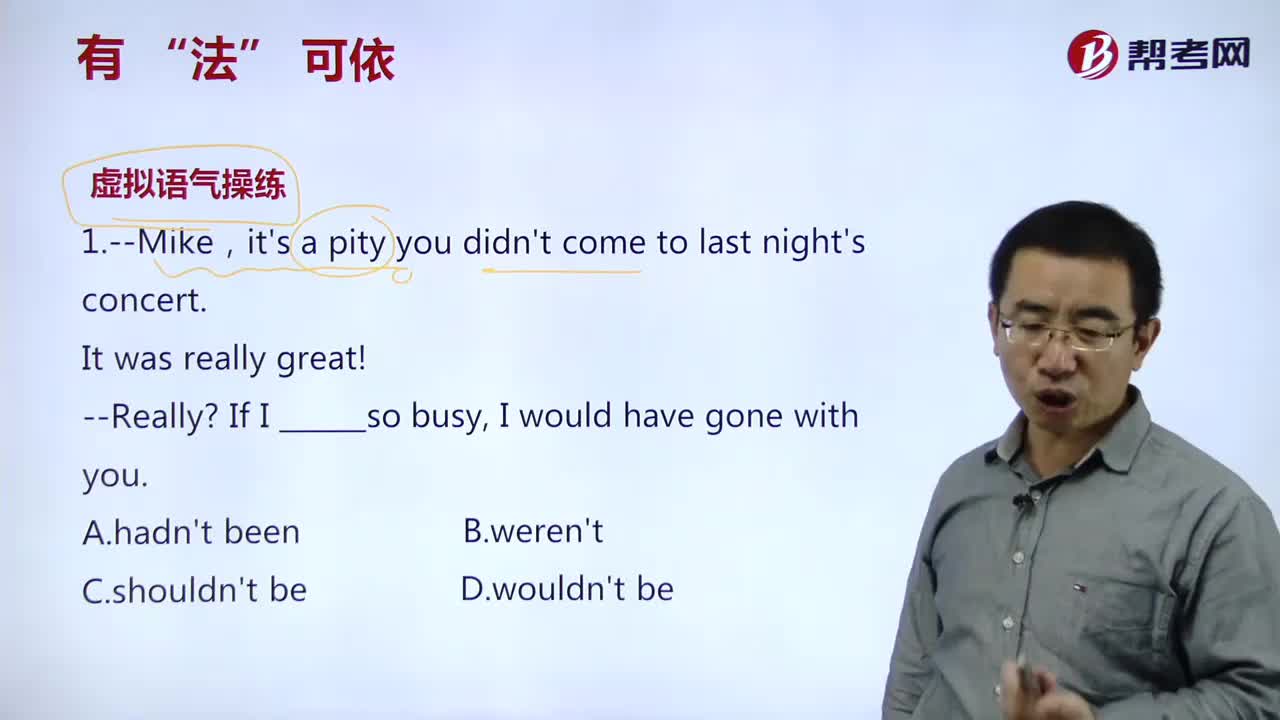
8、It's high time you( ).【單選題】
A.goes wrong
B.would start to work
C.started to work
D.had started to work
正確答案:C
答案解析:【譯文】你開始工作的時(shí)間到了。
【解析】It is (high) time that...后面的從句謂語(yǔ)常使用虛擬形式,動(dòng)詞要用過(guò)去式或用should加動(dòng)詞原形,但should不可省略,故選C。
9、Hardly()he got out of the court()the reporters raised a lot of questions to him.【單選題】
A.had...when
B.had...than
C.did...when
D.has...than
正確答案:A
答案解析:【譯文】他一從法庭出來(lái),記者們便向他提了許多問(wèn)題。
【解析】Hardly had S + Ved when S' +V'ed 與 No sooner had S + Ved than S' + V'ed 都是常見的句型,意思一樣,都表示“一……就......”。
注意 主句的謂語(yǔ)動(dòng)詞一般都用過(guò)去完成時(shí),when從句的謂語(yǔ)動(dòng)詞用一般過(guò)去時(shí)。
【點(diǎn)睛】否定性副詞或狀語(yǔ)置于句首,修飾謂語(yǔ)動(dòng)詞,此時(shí)需要將句式做倒裝處理。
10、For Latins【閱讀理解B】
A.they have a closer intimate distance than Americans
B.A 1979 Harris poll changed people’s opinion about the role of this country in world affairs
C.marking packages “Gift” may not be useful to escape duty payment
D.they usually make some compromises in order to cater to the needs of foreign visitors
E.curling the finger to oneself means good-bye
F.waving farewell is meant to bring a person closer to him
G.restaurant menus are rarely translated into multilingual languages
正確答案:A
答案解析:他們的身體親密距離要比美國(guó)人更近。定位到原文第二段最后一句話,他們喜歡離得近,并且觸碰對(duì)方,這使美國(guó)人很不舒服。
 05:31
05:312020-05-15
 02:38
02:382020-05-15
 04:04
04:042020-05-15
 03:35
03:35 04:00
04:00
微信掃碼關(guān)注公眾號(hào)
獲取更多考試熱門資料